

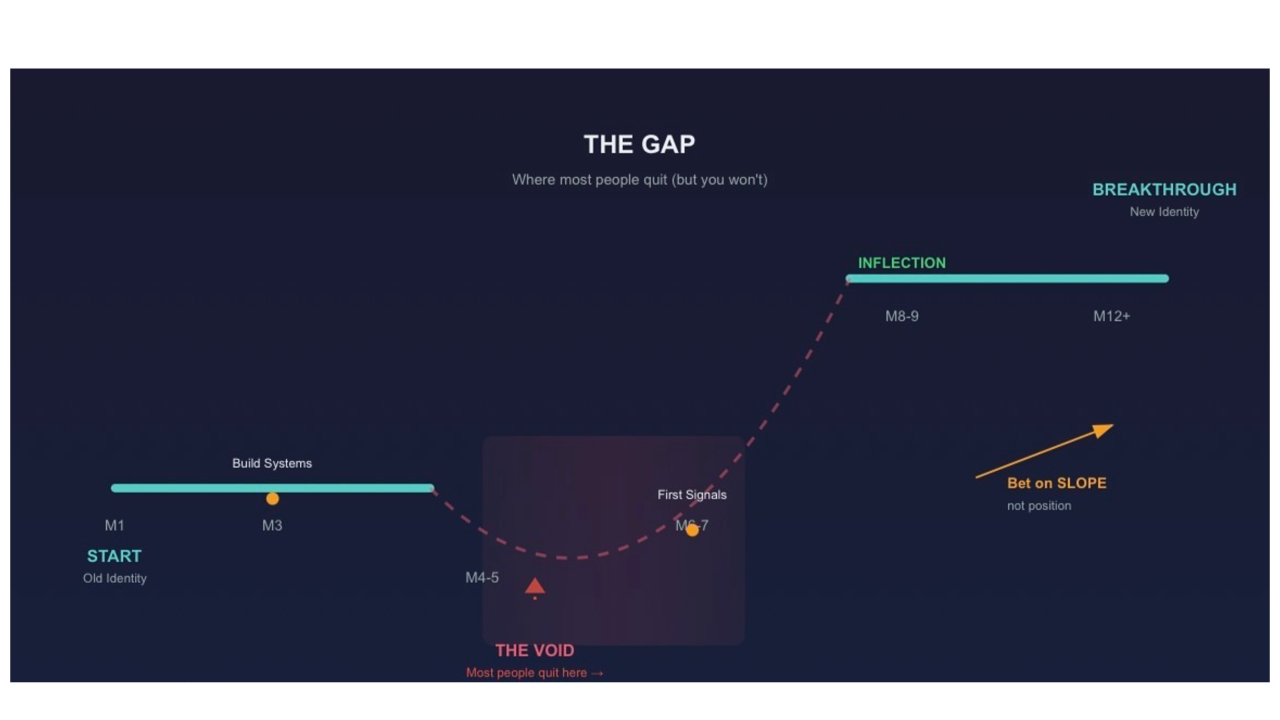
During major transitions — whether in career or life — you are essentially building a plane while falling through the sky. Most people think they need more courage, better ideas, or stronger networks. But the real need is for infrastructure that works even when your brain doesn’t.
Without this infrastructure, transition stress — emotional, identity-based, informational, and instrumental — often leads to quitting, usually between months 5–9, sometimes just before a breakthrough.
The Hidden Cost of Reinvention
Transition isn’t just chasing a dream — it’s trading your existing scaffolding for a steeper trajectory. You let go of social capital accumulated over decades, internal confidence built on familiar patterns, and reliable decision-making frameworks that no longer apply.
Many executives expect to lose title or salary — that’s predictable. But what hurts is the neutral zone: the ambiguous gap where the old identity has partially fallen away but the new one hasn’t fully taken shape yet. Those who interpret this phase as failure often give up. But those who recognise it as a normal part of transformation are the ones who break through.
Why Most People Struggle
The gap between old and new identity creates three common breakdowns:
A) Metric Failure: Old Maps Don’t Work
During transition, your old performance metrics — titles, salary, revenue, quarterly reviews — no longer measure progress effectively. These indicators gauge terrain you’ve already left behind. They can mislead more than guide.
B) Identity Failure: Internal Compass Collapses
Many people build their sense of self around past roles or achievements. When those vanish, the internal compass fails. Without a redefined sense of who you are becoming, uncertainty feels like evidence of a wrong decision.
C) Validation Failure: Silence Instead of Praise
Transitions lack the external affirmation you’re used to. No quarterly wins, board approval, or peer recognition. Instead, there’s silence and small incremental progress that’s hard to detect — leading many to question if they’re on the right path.
The Support Infrastructure You Actually Need
What makes the difference between quitting in the void and pushing through to breakthrough success is a support infrastructure designed for transition. The theory of predictable failures means that if you build this infrastructure proactively, your trajectory improves dramatically.
Role 1: Emotional Support
This is someone who validates that what you’re feeling is real — a friend or family member who has walked through a major transition themselves. Their role is not to fix you but to help you survive the fall.
Role 2: Appraisal Support
Like a coach in the corner of a boxing ring, this person reviews your progress, challenges assumptions, and helps you see what you’re missing. They help you stay sharp and grounded.
Role 3: Informational Support
This is the domain expert a few steps ahead of you — someone who answers technical questions, connects you to resources, and translates unfamiliar terrain into familiar patterns.
Role 4: Door Opener
This person has access — capital, connections, or platforms — that you currently lack. Use their support wisely. Be grateful, and pay it forward later.
Building this support network early — before you need it — increases the probability that you’ll reach “escape velocity” in your transition rather than stall or quit.
Closing Thoughts
You are in between worlds. It’s disorienting, exhausting, and often lonely. But the difference between those who make it through and those who don’t often isn’t talent. It’s having the right infrastructure and support system in place.
Transition doesn’t feel like success until you’re on the other side. But with the right people around you, you can build that path — even when the fog of change makes everything uncertain.